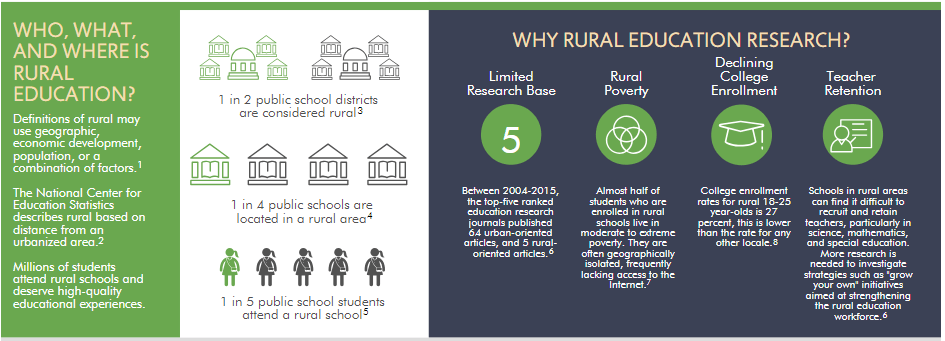
Approximately one-half of school districts, one-third of schools, and one-fifth of students in the United States are located in rural areas. Rural schools face a variety of barriers and challenges including: poverty; lack of post-secondary opportunities; teacher isolation; and teacher turnover. Rural schools are in a unique position to overcome these barriers because they are set in a community context that values a sense of place and appreciates meaningful business and industry partnerships to support students’ success.

Partnership is key
These partnerships are valuable because they provide the resources, professional expertise, and practical curriculum that can have a powerful impact on students’ learning experiences. When students have the opportunity to engage in authentic instruction and problem-based learning, they are more equipped to think critically about problems in the real world. Real world connections help students to understand the relevance of academic content to a variety of careers.
© 2017 Education Development Center, Inc. All rights reserved.
Rural communities have seen a rapid growth of STEM technician occupations. Unfortunately, in many rural school districts, there is a math gap in what students learn and what these occupations require in a rural region. How can we better align instruction to reinforce the skills that students need for high-demand occupations? This question prompted a discussion between business owners and the K-12 educational community in Virginia. As a result, Virginia’s Chamber of Commerce prioritized school / business partnerships and workforce preparation as important goals to strengthen the state’s economic development and global competitiveness.
The Rural Math Innovation Network helps to support the Chamber’s goals by providing an opportunity for educators to partner with STEM and health (STEM-H) technicians to incorporate real-world math competencies into their instruction. Modified DACUM (Developing A CUrriculuM) sessions, during which educators design instruction side-by-side with STEM-H technicians, are powerful learning experiences for educators to leverage the expertise of business and industry professionals. These sessions provide transformative training for educators to learn how apply pre-Algebra and Algebra I concepts and skills to tasks and responsibilities in the workplace to make lessons relevant and more meaningful for students..
 The Rural Math Innovation Network helps to support the Chamber’s goals by providing an opportunity for educators to partner with STEM and health (STEM-H) technicians to incorporate real-world math competencies into their instruction. Modified DACUM (Developing A CUrriculuM) sessions, during which educators design instruction side-by-side with STEM-H technicians, are powerful learning experiences for educators to leverage the expertise of business and industry professionals. These sessions provide transformative training for educators to learn how apply pre-Algebra and Algebra I concepts and skills to tasks and responsibilities in the workplace to make lessons relevant and more meaningful for students..




 Antoinette Jenkins
 Leah Williams-Rumbley
 Zuzana Steen
 Beth Rhinehart
  Kristie Proctor
 Deborah Jonas
 Andy Gail